Posts

Showing posts with the label experiment

Rage, a game for 3

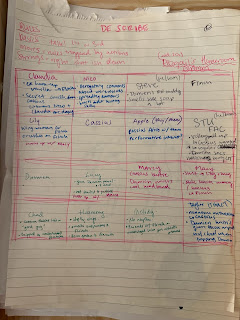
"You've ruined everything. I will hate you forever." A game for three players, A, B, and C, shifting roles. Brief definition of a human being for play purposes "Human being" is a keyword I've found useful in playing several narrativist games. When I say so-and-so is a human being, I mean that they are not a structural literary type (pro- or antagonist), a cardboard cutout, a stereotype, a pawn, a monster, a simple player stand-in, or a political or moral idea given fictional flesh. Most human beings have all of the following  Name Age Ethnicity Social class Income (or none!) Hometown Current city A job, and previous work experience (or none!) Sexual and romantic relationships (or none!) Friends (or none!) Family (or none!) Hobbies and interests Material resources  It isn't necessary to fill out every detail, just enough for our current play. You can always add more later. Scenario creation I Player A creates the main girl, a human being between the ages ...

OSRs Magica: Muspelli

Image
The Muspelli are are Hyberborian magicians who worship the giants and aim to bring about Ragnarok. They have specific giants as patrons. They learn to take on the form of a giant, at least the size of a bear. Creating your Muspelli Muspelli advance and roll HP as other magician classes. They do not memorize or research spells. Instead they commune with a giant to master their transformation into giant-form and improve their ritual ability. Roll for a patron: Aegir Sea-King. You know Storm's Eye, Twisting the Sight, Threads of Fate, and Dowsing. +1 bonus die on all casting rolls if you are crippled (legs smashed on rocks while swimming) Gullveig the Wicked. You know Entrancement, Hex, Summon Animals, and Magic Sensitivity. +1 bonus die on all casting rolls if you are blind (plucked out own eyes) Gymir Frost-Father. You know Storm's Eye, Winter's Breath, Wildfire, and Wilderness Sense. +1 bonus die on all casting rolls if you have three heads. Leikin Hel-Queen. You know Hex, ...

When do you need a GM?

Image
Traditionally RPGs centralize many responsibilities and authorities in one player, the GM. That's not necessarily bad, but it isn't necessarily good, either, and it's certainly not mandatory. I am going to look at some traditional functions of the GM to see why we put them in one player's hands, and how we might distribute the responsibility for these functions differently. A GM traditionally does a whole bunch of different things: Pitches the game Organizes play sessions, including recruiting players Knows the rules and teaches others Leads creatively Creates the background ("worldbuilding")  Creates the scenario for play Runs dramatic coordination Frames scenes Says "what's going on" generally Plays all side characters Resolves in-game tasks and conflicts Pitches the game, organizes play sessions, knows the rules. If the entire play-group is interested in gaming and excited about games, anybody should be able to do these things. (This or that ...

Reconstructing Ars Magica: the basics

This post gives new magic rules inspired by Ars Magica. It's written for my own fantasy heartbreaker, but it should be compatible with most or all OSR games. Try using this in place of your Magic-User's normal magic rules, or add these as variant casting and spell-learning rules for a different casting class. These rules offer supreme flexibility and extensibility for a sort of magic grounded in magical traditions. I provide links to the traditions at the bottom of the post. These rules also model spell research, including the creation of brand new spells, better than any I have seen in any OSR game. What a spell is A spell is a combination of a noun and verb, spoken out loud, plus some gestures and effort. Your specific magical tradition is going to give you the specific list of nouns and verbs that can combine to form a spell. The same noun-verb combination can be used to cast a bunch of different spells; the noun and the verb just give the basic family of effects. For instan...

Reconstructing Ars Magica: Gruagachan

Image
Skimmed through the Ars Magica book Hedge Magic this morning. Pretty much every hedge tradition listed there is more interesting than the default Hermetic magic. It's a better use of my time to adapt these cooler magic rules than the main ones. These are simpler, too! An image of a Gruagrach from the Ars Magica book on hedge magic. Might as well pretend this is "fair use" You won't be able to use this without the material in the Ars Magica conversion basics . Gruagrachan (how do I decline this noun? gotta look it up at some point) magic is inspired by the Picts and druids and all that. Roll 4d18 (lol) for your starting spells (see below for spell descriptions) and take "some practice" at every skill necessary to cast the spells. If you've got two spells using the same noun, bump up the skill level by 1. If all your spells use the same verb, bump up the skill level by 1. Blessing of Urban Wisdom for the Rustic Blessing of the Swordsman's Expertise St...

Reconstructing Ars Magica in D&D: motivations and dials

Image
The magic rules in D&D are deficient from a literary perspective, and played out from a wargaming perspective. (To be clear, I think Vance is great, but D&D's "Vancian" magic is not particularly Vancian.) So I'm looking for replacements for my fantasy heartbreaker. Most likely I'll try to assemble lots of different rules for magic. We'll choose whatever combination of rules fits the setting for an individual game. I'll make no attempt to harmonize or balance them; we'll simply see how they interact. A set of magic rules that come highly recommended I skimmed Ars Magica once. The magic rules seem really cool, though I have little interest in the game itself. So let's try reconstructing it for the heartbreaker. Here are some salient facts about magic in Ars Magica: Spells have levels/magnitudes. There are guidelines in the book on making new spells at a given magnitude, or finding the magnitude of a given spell. Must review these. The magnitu...

Combat overhaul: desiderata

Image
I've been using a slightly modified version of Eero's combat structure for about a year, and my brand-new attack procedure for about a week, and I like both. Why? What's so good about them? What's so good about any combat procedure whatsoever? I'll start by narrowing the field a bit. I'm only interested in combat procedures for a war game that's roughly compatible with classic D&D modules. The procedures need to scale from ordinary humanity to pulp action heroes. (Conceivably it could go higher than that, but I've never played a game that is that high level, so I don't really care.) The procedures need to take as inputs the kinds of things we find in a D&D dungeon key and monster write-up: number, defenses, level, special abilities, place in the dungeon ecosystem. It doesn't have to use all those things, but it can't ask for any information outside of those things. Ok, that's it for hard requirements. Now let's list the thin...

Combat overhaul: structure

Image
This is mostly a summary of the Coup procedure, so credit where it's due there. I've added the bit about different action speeds as it's come up in games a fair deal. Maneuvering Combat is divided into 1 minute maneuver phases. Declare what you are doing at the start of the phase. Everybody declares at once, no particular order. Actions in the maneuver phase are immediate, fast, or normal. Every action in a speed category takes place simultaneously. Fully resolve all actions in one speed category before you move on to the next. Conceivably, your action could take some sort of penalty if you are disrupted by an action from an earlier category. Immediate actions: shooting an arrow, throwing a spear, tossing a rock, readying a spear, giving a brief command, charging into melee (maybe? this is separate from the ordinary walking-speed "closing into melee" and requires a martial arts technique to get a whole group to do it at once) Fast actions: closing into melee Norma...

Combat overhaul: attack algorithm

Dice tech basics When you make a check of TN/D difficulty, you want to roll TN or lower on a D-sided die. Call that a hit, otherwise, the die is a miss. Sometimes you'll modify the roll by adding bonus dice (roll an extra die of the same size and take the better result), penalty dice (roll an extra die of the same size and take the worse result), or changing the target number (TN). If you would increase TN to the point where the task is a sure thing (in other words, TN = die size), bump up the die size instead and increase the TN accordingly. (So a task gets easier as 4/6, 5/6, 7/8, 9/10, 11/12, 19/20...) Similarly, if you would ever decrease TN to the point where the task is impossible (in other words, TN = 0 or less), keep TN the same and increase the die size. (So a task gets harder as 2/6, 1/6, 1/8, 1/10, 1/12, 1/20...) If you have both bonus and penalty dice, cancel out one of each until you have only bonus dice, only penalty dice, or neither. Now, roll the dice. If you have a...

Simple downtime maneuvers

 In my Arcade Mode game, players don't take downtime. They freely adjust their resources between sessions. That was the intent, anyway -- most players are unwilling to simply give themselves more resources. So I decided to draft a very simple downtime system. Every real world week, or every session, since your last session with a character, add 1 downtime point. Spend downtime points and (10 * level * points) rupees on downtime actions. (The rupee is your campaign's base currency type, whatever that is. 1 rupee = 1 xp = 1 days' wages for a basic infantryman, roughly.) Here are some simple downtime maneuvers, listed with their costs: 1 point = 1 streetwise check for new hirelings, rumors, rare items, contacts, trainers 1 point = 1 visit to a known sage, library, expert, important contact 1 point = 1 martial art technique learning check 1 point = 1 hireling recruitment roll 2 points = reroll HP, take the higher result 2 points = 1 attribute improvement roll 3 points = train ...

Medieval economy and production, plus some equipment listings

Image
I'm not a historian. If you want real knowledge, go to a historian. If you want something gameable, read on. The market in medieval times was not the supermarket of today. Obviously! People brought goods to market in market towns, about twice a week. On such days you can buy any common good, straight off, from a stall. If it's not a market day, you can still buy food, but you'll have to order other items from workshops. (Small towns have markets every week or every two weeks.) Prices are generally static throughout the medieval period, for a few reasons -- constant deflation from the trade balance with Asia, relative stagnation in the productivity of labor, and, most importantly, laws setting price ceilings on common goods, and trade unions setting prices for everything else. So you don't need to worry about modelling dynamic prices for goods. You do have to worry about the availability of goods, and the time it takes to produce them. Basic price list So if the gang wa...

Draft of "The Basic Game Manifesto"

# Basic game manifesto The basic game is a variant on traditional challenge-focused fantasy spelunking tabletop roleplaying. While it is very common in our community (the OSR), I do not think we usually play it intentionally, nor have we articulated its possibilities and limits. I intend to explain the nature of the basic game and its charms. Briefly: The basic game begins at the dungeon's door. Players set the terms of the scenario as they please, essentially choosing the scenario's difficulty. Players do not even have to request equipment, levels, or hirelings from the referee -- they simply declare what they have. Once the scenario has begun, the referee adjudicates events neutrally, with an eye towards realism rather than any particular outcome or desired "balance". I am playing a self-consciously basic game because my work schedule does not allow me to run an extended campaign; because I am interested in concentrating the challenge of a dungeon adventure game...